

The first thing that happened to me when I started my conformation journey is that I was told that my dog was field bred. I had so many questions about what on earth they meant. I quickly took to Facebook and found a few conformation groups. I posted a picture of my dog asking for help and constructive criticism.
That is not what I was met with…..
I had people from all over telling me that he was terrible in different ways, but one thing I heard again and again was that he was field bred. I decided to try to better my understanding on what these people meant.
It turns out that field bred and show bred have varying means when I asked different people.
These terms seem to be emotionally charged and not to one meaning. I’ve asked breeders, handlers, trainers, and just people in the dog world what it meant to them, and they all had similar yet varying definitions of the same terms.
A little while later, I learned about type. Type seems to be the more acceptable term to use nowadays. I’m unsure if it is because the emotional charge “show bred” and “field bred” have to them, or because it’s more subjective. So we will be using type from here on in this article. “Type” is defined by the AKC as physical features and characteristics that define a breed, although they acknowledged that people may also be talking about the differences between two dogs of the same breed (Pepper, 2017).
This is simply a compilation of information that I have gathered on each side of the same breed since hearing about the differences. Many people agree that there is only one breed standard so theoretically there should be a common foundation of breed type. In reality, however, there are noticeable differences in how breeders interpret and prioritize that standard. Many breeders or dog fanciers of the breed can tell which kennel a dog came out of just by looking at a dog.
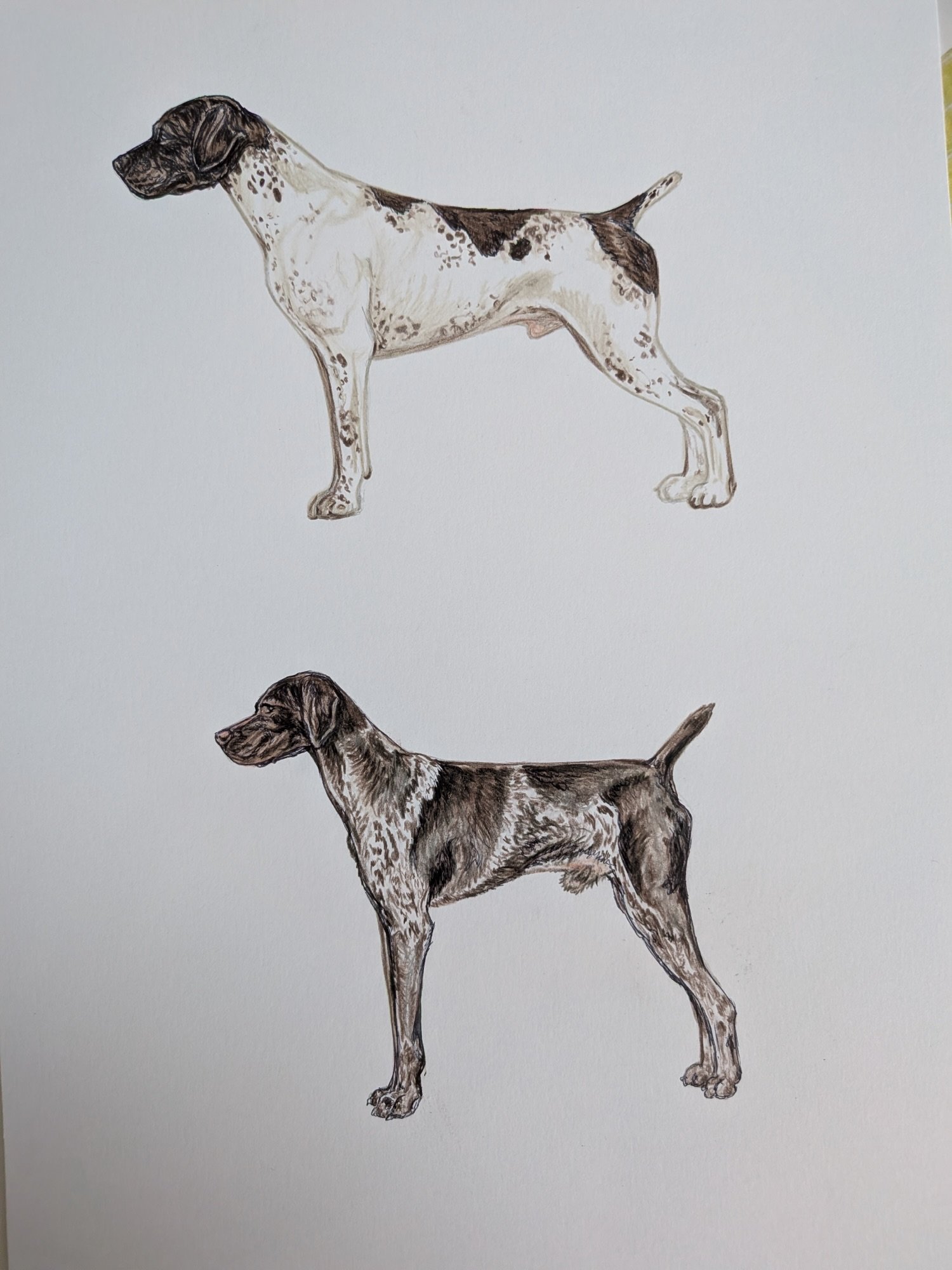
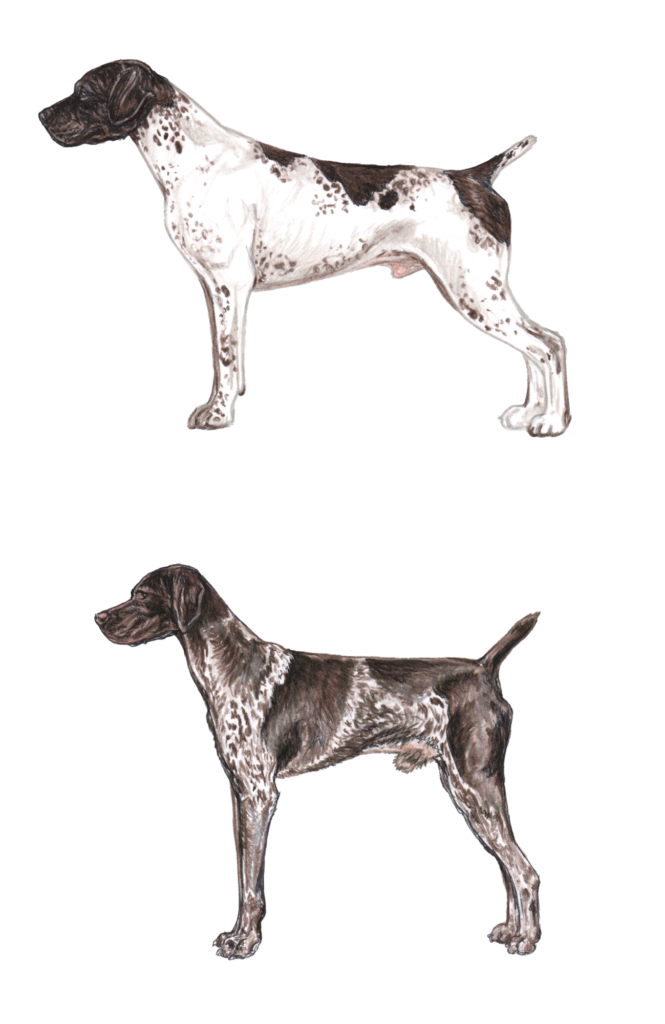
The image above shows the difference between styles or types of dogs. This is an example of a show type (top picture) and a field type (bottom picture). The bottom picture is actually a drawing of my own dog Tysgan. Keep in mind that dogs of the same breed may look similar or different then the illustrations provided. If you would like to see what the ideal GSP looks like, please visit the GSPCA website for their illustrated breed standard. Neither example in the image of the dog on the top nor the bottom is a representation of the ideal. They are just examples of dogs that I have seen in the show ring that help to illustrate what I am talking about in this post.
My dog was purchased by a breeder who hunts and doesn’t show. He tends to be narrower, leggier, and not as thick or big boned as some of the dogs I am seeing in the show ring. We have learned a lot about conformation by bringing him into the ring to compete against other GSPs. It can be very daunting to bring your own dog into the ring to get judged, but you have to start somewhere.
What I have heard:
There are many different personal definitions that I have heard about what being a show or field type means.
- Field type dogs are any dogs of that breed that do not have correct structure.
- Field type dogs are only dogs that have a pedigree with hunting or field champions.
- Field type dogs are dogs that look a certain way (thinner in bone and substance, less angulation, chests not as deep).
- Show type dogs are only come from a pedigree with dogs who have reached at least a CH in conformation.
- Field dogs can still do ok in the show ring, but they are more of a disadvantage.
- Some show dogs have a disadvantaged to the field.
What I have learned:
- Dogs can come from a field heavy pedigree and have excellent structure.
- Dogs can have a conformation heavy pedigree and have structural faults.
- Dogs can have field champions behind them and still resemble what someone might call a “show type”
- Dogs can have conformation champions behind them and still resemble what someone might call a “field type”
- A dog can have conformation champions behind them and still be excellent hunting dogs.
- Dogs can simply look different from dogs winning in the ring without being structurally incorrect.
- Many people have their own definition of what a field or show type dog means to them. With this in mind, when having a conversation with someone on any topic, make sure to clarify if you are both talking about the same thing.
In my research, I found that in the GSPCA yearbooks from 1975-1977, dogs were broken down into “types”. For example, on page 28 of the 1977 yearbook, it states “1977 sire-of-the-year (Dual Type)” and on the opposite page it states “1977 sire-of-the-year (Show Type)”. The book goes on with “field type” and even “obedience type” later in the book. I believe that this suggests that the GSP community was using “type” terminology in that period. The types are no longer listed in current yearbooks that I have seen, and I wonder if that is because people are trying to minimize the differences. While this was an interesting find in my research, I do not have enough information about it to speak on this matter.
Conclusion:
I came into this assuming that “field bred” had a more clear definition. The more I researched, the more I realized that different people use the term to describe lineage, physical appearance, performance goals, or even perceived conformation quality. Those aren’t necessarily the same thing. Ultimately, there is one standard for the GSP. The interesting question isn’t whether a dog is labeled field or show but how breeders interpret that standard while selecting for different priorities.
Whether someone has labeled your dog a field type or a show type GSP, you have the greatest dog and don’t let anyone tell you otherwise. Bringing my not so show dog into the ring introduced me to so much, good and bad, and I am so grateful that I have a beautiful dog that I can learn so much with. We are on our journey to get his Championship, even if it takes years! And maybe you’ll see us out there! Good luck with whatever fun things you are doing with your GSP! They will not let you down!
Note to the Reader:
Use discretion when reading anything online. You may find that your experience differs from mine, but that does not invalidate the things that I have written and learned in my time. Question everything, and I encourage everyone to do their own research.
As always Read, Learn and Share – Chasing the Scandal
Refrences:
- Spira, Harold R. Canine Terminology Harold R. Spira. 1982.
- Spirer, Louise Ziegler, and Herbert F. Spirer. This Is the German Shorthaired and Wirehaired Pointer. T.F.H. Publications ; Distributed in the U.S.A. by T.F.H. Publications, 1970.
- German Shorthaired Pointer Club of America. (2015). The German Shorthaired Pointer illustrated standard (P. Titus, Chair; P. Fullford, Illus.).
- Pepper, Jeffrey. “Type: The Breeder’s Foundation.” American Kennel Club, 20 Nov. 2017, www.akc.org/expert-advice/dog-breeding/type-the-breeders-foundation/.
- Hunsburger, Dale. “Breed Type Defines the Breed.” American Kennel Club, 19 Sept. 2018, www.akc.org/expert-advice/dog-breeding/breed-type-defines-the-breed/.
- Birge, Elbert. et al. German Shorthaired Pointer Club of America INC., 1997.
Leave a Reply